
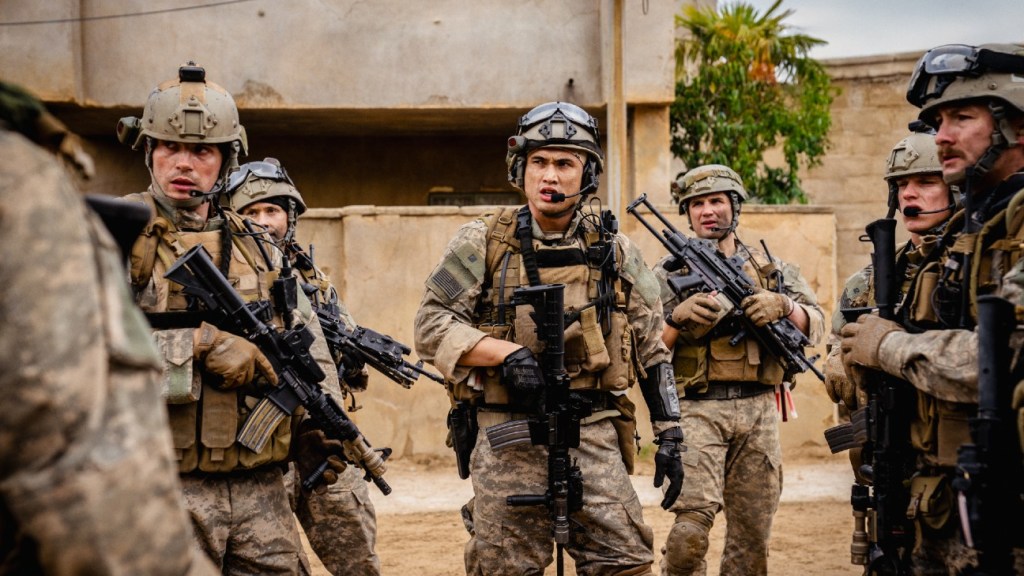
Warfare (2025)
Alex Garland and Ray Mendoza
After surprisingly loving Alex Garland’s Civil War last year, I knew that I had to check out his next movie, especially after hearing that Warfare’s depiction of the Iraq War was alarmingly immersive. That much was true and more, and I came out of Warfare pretty shell-shocked—suffice it to say it was a “no-music” car ride home.
From the opening beats, Garland sets the camera alongside this platoon and lets the horrors play out. Honestly, the first half-hour or so was impressive insofar as this platoon was masterful in their execution and seizure of the Iraqi home that became the setting for the rest of the film. That first act also really established the camaraderie between the members of the platoon, and I could sense their deep connection to each other throughout the movie. Once the good times ended, though, I locked into my seat and had a very immersive—and very upsetting—viewing experience.
Both the sound design and the claustrophobic cinematography created a very scary, unsettling environment where even I watched every window and crack in a door, waiting for the gunfire to resume. Both the sound mixing and the sheer volume of the gunfire, radio communication, and the screaming—which is sure to be in my nightmares—were horrifyingly Oscar-worthy, and I hope this film doesn’t get forgotten because of its early release date.
For the last hour of the film, I was watching in terror and with bated breath, sure that more fire was on its way. Warfare surely excelled in its insistence on real-time storytelling, forcing the viewer to experience all of this story’s atrocities alongside the men fighting. That difference made it a demonstrably separate experience from Civil War, and while it was certainly great and memorable, I probably prefer Civil Warfor its unique journalistic perspective and prioritizing developing their characters.
I thought the performances from the actors I knew—and the actors I didn’t, I’m not blind to them—were impressive, especially from Will Poulter (a totally different Poulter than the one that was in Death of a Unicorn), Noah Centineo, and Kit Connor (how do you go from Brightbill and Broadway to a flim like this? Boy’s got range). Charles Melton gave a solid performance, too, though I wished he had been in the film more.
Above all, Warfare was as close as I will ever get to experiencing the horrors of war (or the horrors—and I’ve heard, joys—of war video games, which I’ll be staying away from for a while, too) with scarily good sound design, a group of close, committed actors, and a visceral and downright scary depiction of war. Never have I felt like I was going to cry at a movie out of fear, but I felt close tonight, and all the credit goes to Alex Garland and the young men he cast for this film.






 Nate At The Movies
Leave a comment